
8 diagnostic questions. 25 marks. 30 minutes
Built from recurring question structures in past PSLE Math papers. Your child attempts the questions first — independently, just like the real exam.

Attempt first. Then watch the framework walkthrough
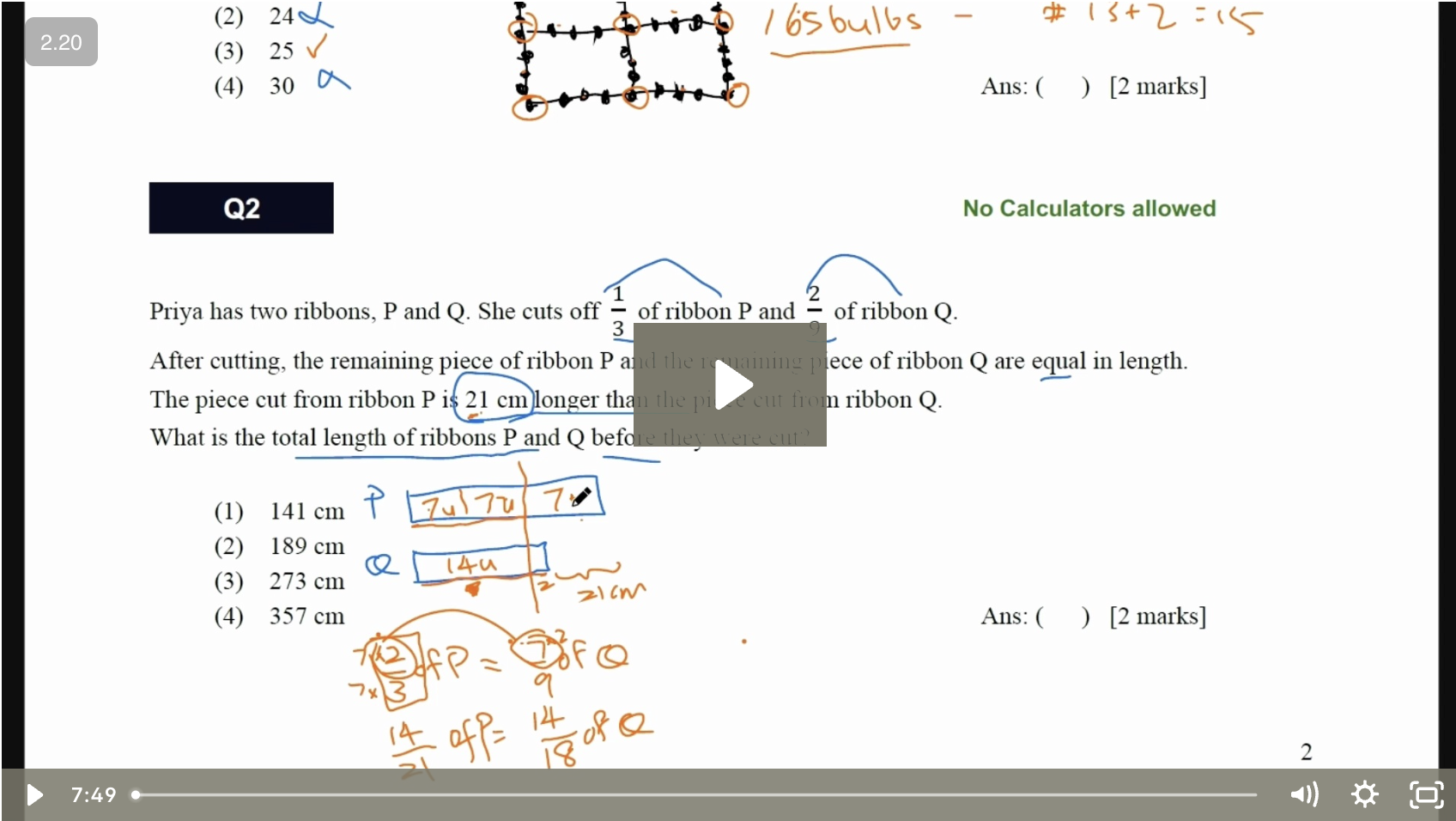
After submitting answers, each question unlocks a video showing exactly where most students get stuck, the specific framework that resolves it, and how to spot the same structure in future papers.
A Results Guide that tells you what to do next
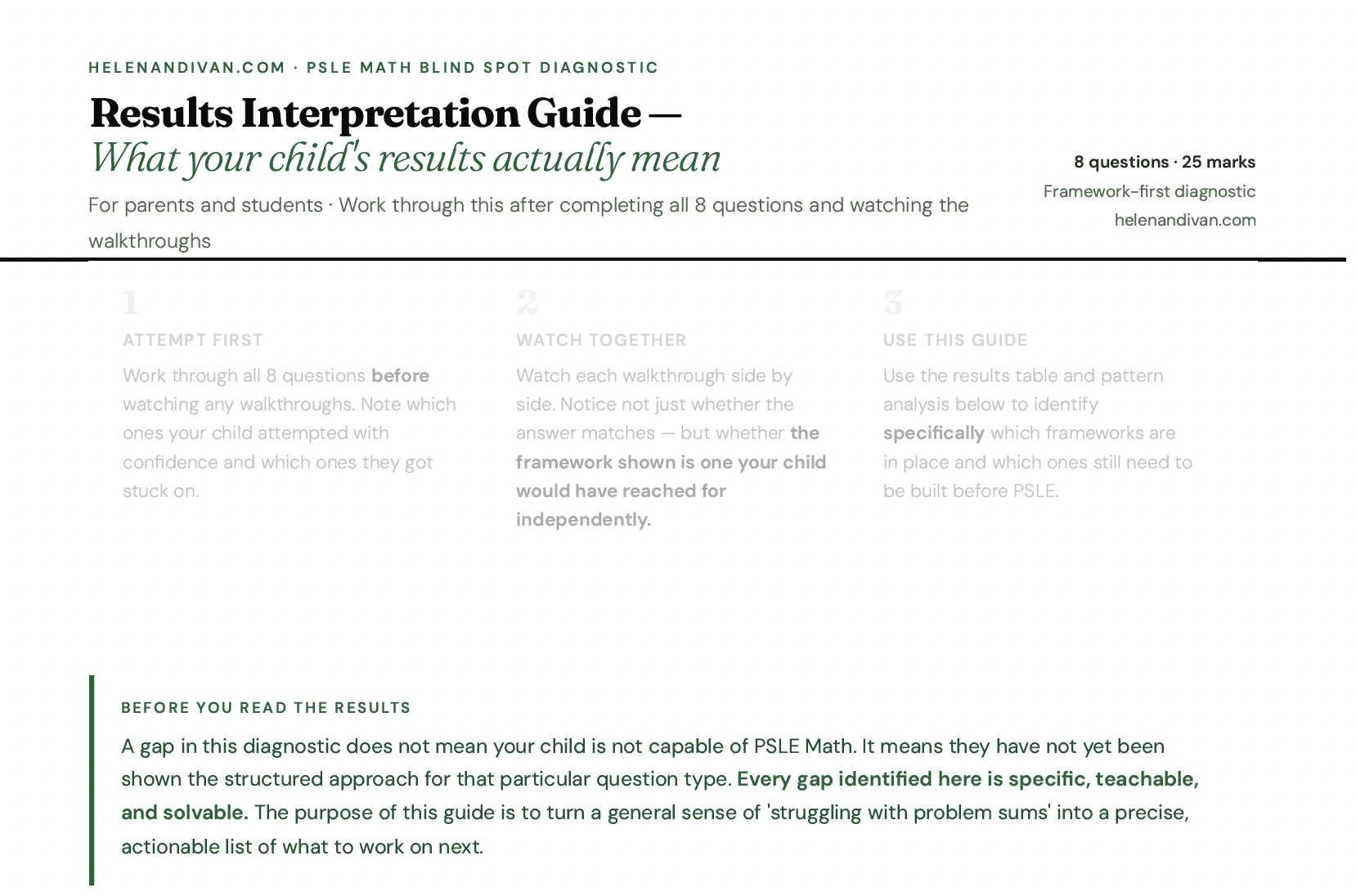
The Results Interpretation Guide maps your child's score to a likely AL band and shows you exactly which question structures to prioritise — with the biggest impact on marks.
What you will uncover
This is a diagnostic test, not a lesson. Your child works through 8 questions — 25 marks, 30 minutes — drawn from recurring question structures across the last 10 years of PSLE Math papers. No instruction before. No hints during. Just the questions, exactly as they would appear in the exam. When they submit, the walkthroughs unlock. Each of the 8 videos shows the framework behind that question type: why students who don't know it get stuck, and why students who do know it solve it in under 3 minutes. What comes with it: → 8 video walkthroughs — framework first, not just the answer → The Framework Reference Card — all 8 approaches on one page for revision → The Results Interpretation Guide — which AL band your child is currently on track for, and where to focus next
What's inside — after the diagnostic
The diagnostic paper is in Chapter 1. Chapters 2–9 unlock after you submit your answers. Chapter 10 contains the Results Guide.
PSLE Math Blind Spot Diagnostic
-
1
-
(Included in full purchase)
Overview
-
(Included in full purchase)
How to use the Diagnostic Paper
-
(Included in full purchase)
Download the Diagnostic Paper
-
(Included in full purchase)
Submit your answers to unlock solutions walkthroughs
-
(Included in full purchase)
Solutions Summary
-
(Included in full purchase)
-
2
-
(Included in full purchase)
Walkthrough and Method
-
(Included in full purchase)
-
3
-
(Included in full purchase)
Walkthrough and Method
-
(Included in full purchase)
-
4
-
(Included in full purchase)
Walkthrough and Method
-
(Included in full purchase)
-
5
-
(Included in full purchase)
Walkthrough and Method
-
(Included in full purchase)
How to master the BCA method?
-
(Included in full purchase)
-
6
-
(Included in full purchase)
Walkthrough and Method
-
(Included in full purchase)
More practices for the Simulatenous Equations method
-
(Included in full purchase)
-
7
-
(Included in full purchase)
Walkthrough and Method
-
(Included in full purchase)
Algebra as a solution framework
-
(Included in full purchase)
-
8
-
(Included in full purchase)
Walkthrough and Method
-
(Included in full purchase)
Tackling similar visual questions
-
(Included in full purchase)
-
9
-
(Included in full purchase)
Walkthrough and Method
-
(Included in full purchase)
The QVT Table method
-
(Included in full purchase)
-
10
-
(Included in full purchase)
Solution Frameworks Reference Card
-
(Included in full purchase)
How to Interpret the Results
-
(Included in full purchase)
Know where your child stands — Before the PSLE Math Exam
The diagnostic takes 30 minutes. The Results Guide tells you which AL band your child is currently on track for, and which question structures -- if mastered -- would recover the most marks before the PSLE